Vietnam Visa for German Citizens
Table of Contents
- Vietnam E-Visa Requirements for German Citizens
- Denied Boarding at Frankfurt Airport (FRA): What Happens When Your Visa Isn't Ready
- The German Passport Trap: Name Formatting Errors That Kill Applications
- VIP Fast-Track Service: Arrive Like You Mean It
- How to Apply for Your Vietnam E-Visa in 2026
- Frequently Asked Questions
If you're researching the Vietnam visa for German citizens in 2026, here's the thing nobody tells you upfront: most of what you've read online is already outdated. The rules changed. The exemptions expanded. And if you're planning a trip longer than 45 days — or you simply want the security of a proper visa document in your pocket — this guide is the one that will actually get you on that plane without a last-minute panic.
Vietnam is extraordinary right now. Hội An is glowing. The food scene in Hồ Chí Minh City has exploded. And German travelers are arriving in record numbers — many of them completely unprepared for the nuances that can turn a dream trip into a nightmare at the check-in counter. I've seen it happen far too many times. Let me make sure it doesn't happen to you.
Vietnam E-Visa Requirements for German Citizens
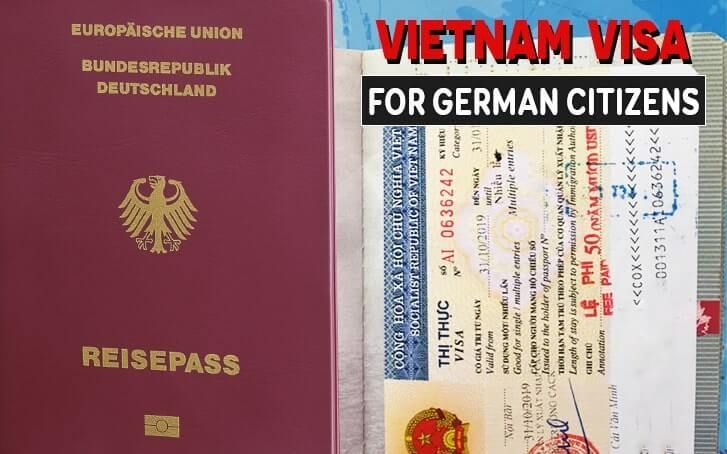
German passport holders enjoy one of the better deals in Southeast Asia. As of 2026, you can enter Vietnam visa-free for up to 45 consecutive days — single entry — without applying for anything in advance. That's genuinely useful for most holiday trips. But the moment you need longer than 45 days, want multiple entries, or want to hop across to Cambodia and return to Vietnam, you need to apply for the 90-day Vietnam E-visa before you travel.
The Vietnam E-visa for German citizens is valid for up to 90 days and is available in both single-entry and multiple-entry formats. Apply once, enter as many times as you like (with multiple-entry), and you're covered. The old Visa on Arrival (VOA) approval letter system that used to require a "letter of approval" before boarding? Dead. Completely obsolete. Do not use any service still selling that — it will cause delays, confusion at the airport, and unnecessary stress.
What you need to apply for the Vietnam E-visa:
- German passport with at least 6 months validity beyond your intended departure date from Vietnam
- Minimum 2 blank visa pages remaining in your passport
- A digital passport photo (4x6cm, white background, face forward, no glasses)
- A clear scan or photo of your passport's biographical data page
- An email address for receiving your approval
- A credit or debit card for payment
Processing is standard 3 business days. Urgent processing (2–4 hours) is available if you're cutting it close — more on that below. The government fee is USD $25 for single-entry or $50 for multiple-entry.
Denied Boarding at Frankfurt Airport (FRA): What Happens When Your Visa Isn't Ready
Let me paint you a picture I've seen play out dozens of times at Frankfurt Airport (FRA), Germany's busiest international hub and the primary departure point for most German travelers heading to Vietnam.
It's 6 AM. Check-in counter opens for your Lufthansa flight to Hồ Chí Minh City. You hand over your passport. The agent frowns. Types something. Frowns again. Your E-visa application — submitted three days ago — is still showing "processing." Or worse, it was rejected due to a name formatting error you didn't catch. Your flight boards in two hours and forty minutes.
This is the moment people call us.
In cases like this, our Super Urgent Visa Service can secure new E-visa clearance through priority channels within 2 to 4 hours. Not a promise made lightly — this is a service we've been running for years for exactly this scenario. If you find yourself stranded at FRA, Munich (MUC), Berlin Brandenburg (BER), or any other German airport, contact our emergency team the moment you realize there's a problem. Do not wait until the gate closes.
💡 Expert Insight from Stanley Ho: "Over my 23+ years handling travel logistics and Vietnam visa services, the most frequent disruption occurs at the check-in desk due to simple application formatting errors. If you are stuck at the airport and denied boarding, don't panic—our emergency team can secure a new E-visa clearance through priority channels within hours, saving your flight."
The lesson? Apply at least a week before departure. And double-check your name formatting before you hit submit.
The German Passport Trap: Name Formatting Errors That Kill Applications
This section matters more than most guides let on. German passports — and German names — have specific characteristics that the Vietnamese E-visa portal does not handle gracefully.
The umlaut problem. German names frequently contain special characters: ä, ö, ü, and the sharp-s ß. The Vietnam immigration portal runs on standard ASCII — it does not accept these characters. If your passport reads "Müller" you cannot enter "Müller" into the form. You will need to use the Machine Readable Zone (MRZ) version — the two lines of text at the bottom of your passport photo page, written entirely in uppercase Latin characters without diacritics.
Here's how German passport umlauts are rendered in the MRZ:
- ä → AE (e.g., Bäcker → BAECKER)
- ö → OE (e.g., Köhler → KOEHLER)
- ü → UE (e.g., Müller → MUELLER)
- ß → SS (e.g., Strauß → STRAUSS)
Open your German passport right now. Look at those two machine-readable lines. Your name there — in that format, all caps, no special characters — is exactly what you must type into the E-visa application. Not what appears on the main page of your passport. The MRZ line is the authority.
Compound surnames. Many Germans carry hyphenated double surnames (e.g., Schmidt-Weber, Hoffmann-Bauer). Enter these exactly as they appear in the MRZ — typically as two words separated by a double chevron (<<) in the raw MRZ, but translated as a space or hyphen in the portal. When in doubt, use a hyphen and match it to whatever your MRZ line shows.
Title fields. German passports sometimes include academic or honorific titles (Dr., Prof.) integrated into the name field. Do NOT include these in the first or last name fields of the E-visa application. The portal doesn't have a title field — stuffing "Dr." into your surname will cause a mismatch.
Get this wrong and your visa application will be rejected, or worse — approved but mismatched with what's in your passport, which will get flagged at immigration in Vietnam.
VIP Fast-Track Service: Arrive Like You Mean It
Even with a valid E-visa, the arrival experience at Vietnam's major airports can range from smooth to chaotic depending on the day, the hour, and the airline schedule. If you're arriving into Tân Sơn Nhất International Airport (SGN) in Hồ Chí Minh City, Nội Bài International Airport (HAN) in Hanoi, or Đà Nẵng International Airport (DAD), our VIP Fast-Track service is worth every cent.
What it includes: a dedicated ground representative meets you at the aircraft bridge or terminal entrance, escorts you through immigration via the fast-track lane, handles your paperwork, and gets you to baggage claim while everyone else is still standing in a queue that stretches to the other terminal. For travelers arriving at Cam Ranh (CXR) for Nha Trang, or Phú Quốc (PQC) for the island, the same service is available on request.
German travelers often underestimate how chaotic peak arrivals at SGN can get. I'm not recommending VIP Fast-Track to sell you something you don't need. I'm recommending it because I've watched business travelers miss connecting shuttles and families lose two hours of vacation time standing in that queue. Your holiday starts the moment the wheels touch down — not when you finally clear immigration.
How to Apply for Your Vietnam E-Visa in 2026
The process is genuinely straightforward if you follow it carefully:
- Go to the official government portal at evisa.gov.vn, or use our trusted service at VisaOnlineVietnam for guided application with error-checking support.
- Enter your personal details — this is where the umlaut rules above apply. Match your MRZ line exactly. First name, last name, date of birth, passport number, passport expiry date — all must be precise.
- Select your entry type: single-entry (valid 90 days from start date) or multiple-entry (same validity, unlimited entries).
- Select your port of entry — you must declare which airport or land border you'll use to enter Vietnam. If you change your route after the visa is issued, you need a new visa. Pick the correct one.
- Upload your photo and passport scan — clear, in focus, no shadows. The portal is picky.
- Pay the government fee — $25 single-entry, $50 multiple-entry. Use a credit card. The payment is non-refundable.
- Wait for approval — standard processing is 3 business days. Urgent options available for 2–4 hour clearance.
- Receive your E-visa via email — print it or save it on your phone. Vietnam accepts both printed and digital copies. Keep it accessible.
One note: the E-visa grants you entry permission, not automatic entry. Immigration officers in Vietnam still stamp you in. Make sure your passport is in good physical condition — damaged passports with unclear biographical pages have caused issues even for travelers with valid visas.
Frequently Asked Questions
Can German citizens get a visa on arrival in 2026? The old VOA letter system — where you'd pay a service to get an "approval letter" and then pay a stamping fee at the airport — is completely obsolete. I'd go further: it's a relic that no longer reflects how Vietnam immigration operates. The 90-day E-visa is the official, legal standard for German travelers who need a formal visa. If someone is still pitching you VOA in 2026, walk away.
How long can German citizens stay in Vietnam without a visa? German passport holders can stay for up to 45 consecutive days under Vietnam's unilateral visa exemption — no application required, no fee. A gap of at least 30 days between visa-free visits is required. If you need longer or plan re-entry, apply for the 90-day E-visa before you travel.
My name has an umlaut — ä, ö, ü, or ß. How do I enter it on the E-visa form? Use the MRZ version of your name: ä → AE, ö → OE, ü → UE, ß → SS. Look at the machine-readable lines at the bottom of your passport photo page and copy exactly what's there, in uppercase, no special characters. Do not use the display version of your name from the top of the data page. This is the single most common error we see from German applicants — and it's 100% avoidable.
Can I extend my Vietnam E-visa once I'm already in the country? Currently, Vietnam does not offer a straightforward in-country extension for E-visas. The standard approach is to exit Vietnam — to Thailand, Cambodia, or even a quick ferry to Phú Quốc from Cambodia — and apply for a fresh 90-day E-visa before re-entering. Some longer-stay travelers combine visa-free entry (45 days) + E-visa entry (up to 90 days) for extended trips.
Is the Vietnam E-visa accepted at all airports and land borders? Yes — the E-visa is valid at all internationally designated ports of entry, including all major airports (SGN, HAN, DAD, CXR, PQC), major land borders, and sea ports. The key requirement is that you must have declared the correct port on your application. If you change your entry point, you'll need to apply for a new E-visa showing the updated entry port.

STANLEY HO
Over the past 23 years in the travel service industry, the growth and success of TRANSOCEAN have stemmed not only from the dedication of our well-trained, enthusiastic, and customer-oriented staff, but also from the exceptional leadership of our Founder and CEO, Mr. STANLEY HO. With more than 20 years of experience in the travel and tourism sector, Mr. STANLEY HO possesses profound knowledge of the market, customer behavior, and modern travel trends. His strategic vision has guided the company toward sustainable growth while maintaining a strong commitment to service quality.