Vietnam Visa for French Citizens
Table of Contents
- Vietnam E-Visa Requirements for French Citizens
- Denied Boarding at Paris CDG: What Happens When Your Visa Isn't Ready
- The French Passport Trap: Accents, Hyphens, and the DOM-TOM Birthplace Question
- VIP Fast-Track Service at Vietnam Airports
- How to Apply for Your Vietnam E-Visa in 2026
- Frequently Asked Questions
Reviewed by: Stanley Ho | Last Updated: May 2026
If you are looking into the Vietnam visa for French citizens in 2026, you are already one step ahead of a surprisingly large number of French travelers who walk into this process carrying information that is two or three years out of date. They have heard from a colleague who visited Hội An in 2022 that you can "sort out a visa on arrival when you land." They are half-expecting a form to fill in at Nội Bài airport, a short queue, a stamp. What they encounter instead is a hard refusal at the check-in desk at Charles de Gaulle — because the airlines pre-clear Vietnam entry documentation before boarding, and an outdated approval letter gets you precisely nowhere.
France is Vietnam's second-largest source market for European tourism. The historical connection between the two countries — the colonial architecture of Hanoi's French Quarter, the baguettes that somehow became a staple of Vietnamese street food, the coffee culture that runs so deeply through both nations — means French travelers feel an almost immediate sense of recognition when they arrive. Hội An, Hà Nội, the Mekong Delta. Every year, more and more French passport holders make the journey, and for 2026, the process has been streamlined to a single, entirely sensible system: the official 90-day Vietnam E-visa, applied for online before you travel.
That is the whole story, really. Online application, three business days, approved by email, valid for 90 days from entry. The old Visa on Arrival approval letter system has been discontinued completely. Any website still selling that document to French travelers is selling you a piece of paper that Vietnamese immigration authorities will not accept and that Air France will not honor at gate. Get the e-visa right, and everything else — the food, the coffee, the light on the rice paddies at dusk — takes care of itself.
Vietnam E-Visa Requirements for French Citizens
The Vietnam E-visa grants up to 90 days in-country on a single or multiple-entry basis. For French passport holders — whether you are based in metropolitan France, in the DOM-TOM overseas territories, or anywhere else in the world — this is the only visa category you need for tourism, short cultural trips, or business visits. No appointment at the Vietnamese embassy on avenue Marin Garat. No courier service. No printed approval letter clutched nervously at CDG. Everything is done online, and your approved visa arrives by email.
What you need before starting your application:
- A valid French passport — must be valid for at least 6 months beyond your intended return date from Vietnam
- A recent passport-style photograph — plain white background, full face forward, taken within the last 6 months
- A clear scan of your passport biographical page — fully legible, no shadows, no glare, all text readable
- A working email address — your approved e-visa document is delivered here
- A credit or debit card — for the application fee
Standard processing takes approximately 3 business days from submission. An urgent processing option can turn approval around in 2 to 4 hours when departure is imminent. The standard e-visa fee is USD $25. The 90-day validity begins on the date you physically enter Vietnam — not the date the visa was issued — so applying a few weeks ahead does not cost you a single day of your stay.
Denied Boarding at Paris CDG: What Happens When Your Visa Isn't Ready
It is a Thursday morning at Terminal 2E, Charles de Gaulle. Your bags are tagged for Hà Nội, you have a strong café waiting in the departure lounge, and Vietnam is roughly eleven hours away via Air France. You hand your documents to the check-in agent. She looks at her screen.
"Monsieur — your Vietnam visa. We cannot see a valid approval."
It happens more often than you would think, and it happens at CDG specifically because Air France runs thorough pre-clearance checks before boarding long-haul flights. The e-visa is still pending — you submitted three days ago but did not account for the weekend, and Vietnamese processing takes three business days, not three calendar days. Or the approval email arrived but the name on the document has a subtle discrepancy: your passport reads François-Xavier with a cedilla in François and a hyphen between the given names, and the portal rendered it differently. The agent cannot accept a visa that does not match your travel document precisely.
The flight boards in two hours and thirty minutes. It will not wait.
💡 Expert Insight from Stanley Ho: "Over my 23+ years handling travel logistics and Vietnam visa services, the most frequent disruption occurs at the check-in desk due to simple application formatting errors. If you are stuck at the airport and denied boarding, don't panic — our emergency team can secure a new E-visa clearance through priority channels within hours, saving your flight."
Our Super Urgent Visa Service processes emergency applications through government priority channels, with clearance typically delivered in 2 to 4 hours. Whether you are at CDG's Terminal 2E, at Orly (ORY) departing on a connecting service, or mid-transit at another hub, call us the moment the problem becomes clear. We have saved flights for French travelers in exactly this situation more times than I can count. The earlier you call, the more we can do.
The French Passport Trap: Accents, Hyphens, and the DOM-TOM Birthplace Question
France produces one of the most beautifully formatted passports in Europe, and it also produces, for reasons entirely tied to the richness of the French language, some of the most reliably problematic name entries on the Vietnam e-visa portal. There are three specific traps that catch French applicants, and every French traveler should understand all of them before submitting.
The accent problem. French names are full of diacritical characters that the Latin alphabet handles elegantly but that the Vietnam e-visa portal absolutely does not: é, è, ê, ë (as in Élodie, Hélène, Bêchir), à, â (as in François, Châtelain), ô, û, ù (as in Côté, Brûlé), ç (as in François, Garçon), î, ï (as in Naïm, Îlois). When a French applicant types their name with these characters into the portal, one of two things happens: the portal silently strips the accent mark, converting Hélène to Helene and François to Francois, or it returns a validation error and refuses to accept the entry entirely.
The rule is the same as for every other nationality: match your name to the machine-readable zone at the bottom of your passport's biographical page. That two-line strip of text, formatted to ICAO standards, converts your name to unaccented Latin — HELENE, FRANCOIS, COTE — and that is exactly what Vietnamese immigration will check your e-visa against. Do not type the accented version. Use the MRZ rendering, without accent marks, and the record will match cleanly on arrival.
The hyphenated given name problem. French given names are famously compound: Jean-Baptiste, Marie-Claire, Pierre-Yves, Anne-Sophie, Louis-Clément. The hyphen is grammatically and culturally significant in French naming convention. The Vietnam e-visa portal, however, treats the hyphen inconsistently — some form versions accept it, some ignore it, and some convert it to a space, producing Jean Baptiste instead of Jean-Baptiste. Again, the MRZ is your anchor: check how the machine-readable strip formats your compound given name and replicate that exactly. If the MRZ shows a space instead of a hyphen, use the space. If it drops the second given name entirely beyond a certain character count, mirror that truncation.
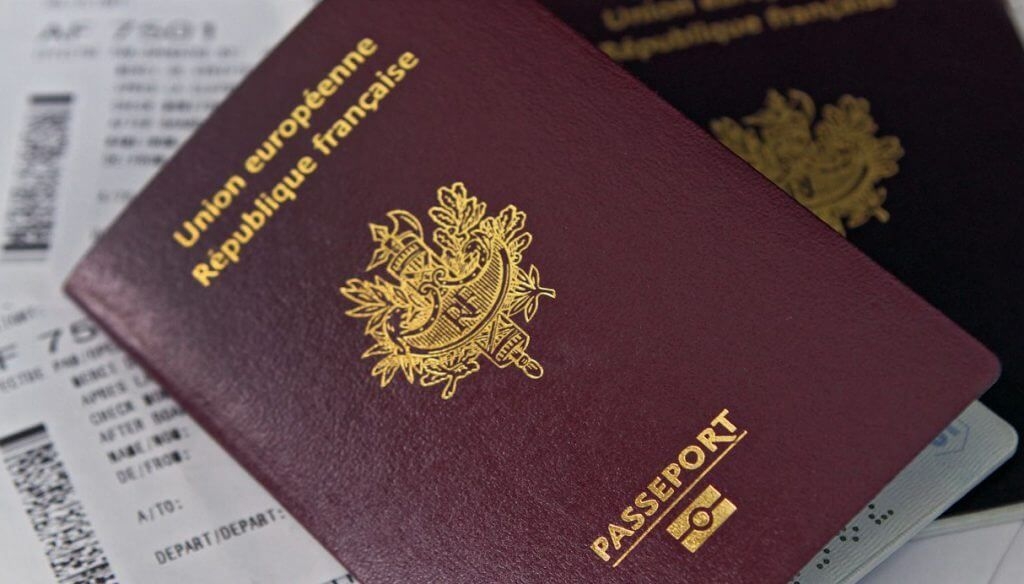
The DOM-TOM birthplace question. France's overseas territories — Martinique, Guadeloupe, La Réunion, Guyane, Mayotte, French Polynesia, New Caledonia, and others — are home to French citizens who hold exactly the same French passport as someone born in Lyon or Bordeaux. The passport is identical in format: blue cover, République Française, issued by the same authority. The only difference is the birthplace listed on the biographical page: Fort-de-France, Pointe-à-Pitre, Saint-Denis, Cayenne, Papeete. This creates no problem whatsoever on the Vietnam e-visa portal. DOM-TOM French passport holders apply exactly the same way as metropolitan French citizens. Nationality is France. Passport-issuing country is France. The birthplace field in the application is simply filled with whatever city name appears in your passport — accent marks again converted to plain Latin as shown in the MRZ.
If you are a French Polynesian or Réunionnais traveler applying from outside metropolitan France, the process is identical. There is no separate application, no additional document, no embassy visit required in your territory. The online process is the process.
VIP Fast-Track Service at Vietnam Airports
After an eleven-hour flight from CDG, the last thing any French traveler wants is to stand in a slow immigration queue at Nội Bài or Tân Sơn Nhất. Our VIP Fast-Track Airport Service removes that final friction from what should be an excellent day.
A dedicated ground assistant meets you at the gate or jetbridge the moment you step off the aircraft at Ho Chi Minh City (SGN), Hanoi (HAN), or Da Nang (DAD). They handle document verification, escort you through immigration as a priority passenger, assist with baggage claim, and walk you through to the arrivals hall. No queuing behind several hundred other long-haul passengers at midnight. No confusion about which lane accepts your visa category.
For French travelers heading directly to the beach destinations — Nha Trang, Phú Quốc — the same service is available at Cam Ranh Airport (CXR) and Phu Quoc International (PQC). After eleven hours from Paris to Vietnam, a clean and fast arrival is the right way to start.
How to Apply for Your Vietnam E-Visa in 2026
The application takes about fifteen minutes when you have your documents ready. The most important thing is to handle the name formatting correctly before you submit — because fixing it afterward requires reapplication, and the three-business-day window starts over. Here is the full process:
- Access the official portal or a trusted licensed service — visaonlinevietnam.com applies human review before submission, specifically catching the accent and hyphen formatting errors that French names regularly generate on automated systems.
- Complete the personal details form — your full name in the plain Latin rendering from your passport's machine-readable zone (no accents, hyphens as shown in the MRZ); nationality France; date of birth, passport number, intended travel dates, preferred Vietnam entry point.
- Upload your documents — a clear scan of your biographical page and your passport photo. Both fully legible and unobstructed. DOM-TOM residents: your biographical page is exactly the same format as metropolitan French passports — upload it as you would any other French document.
- Choose your processing speed — standard (3 business days, note these are business days, not calendar days) or urgent (2 to 4 hours).
- Pay and submit — credit or debit card, processed securely online.
- Receive approval by email — save the document and print a copy if possible. Vietnam accepts both digital and printed e-visas at immigration. If you are traveling with Air France and they request to see your Vietnam entry document at check-in, having it on your phone and in print eliminates any delay.
That is the complete Vietnam visa for French citizens process in 2026. The historical connection between France and Vietnam deserves a journey done without administrative friction. This is how you ensure it stays that way.
Frequently Asked Questions
Do French citizens need a Vietnam E-visa in 2026, or is there a visa-free arrangement?
As of 2026, French citizens are not on Vietnam's visa-free list for extended stays. The 90-day Vietnam E-visa applied for online before travel is the standard and correct route for French passport holders. The old Visa on Arrival approval letter system has been completely discontinued and will not be accepted at Vietnamese ports of entry or by airlines at CDG or ORY.
How long is the Vietnam E-visa valid for French passport holders?
The Vietnam E-visa is valid for up to 90 days from the date of entry, available in single-entry or multiple-entry format. The 90-day period begins on the date you physically arrive in Vietnam, not on the date the visa was issued. Applying several weeks ahead of your departure does not reduce your time in-country by a single day.
My French name has accents like é or ç, or a hyphen like Jean-Pierre — how do I enter it correctly?
Do not type accented French characters (é, è, ê, ç, à, â, ô, û, î, ï) into the portal — it either strips them silently or rejects the field. And for hyphenated compound given names, check carefully how your name appears in the machine-readable zone at the bottom of your passport's biographical page. That plain Latin rendering — JEAN BAPTISTE or JEAN-BAPTISTE depending on your specific passport issue — is the version Vietnamese immigration will check your e-visa against. Replicate it exactly, character for character.
I am a French citizen from a DOM-TOM territory like Martinique or La Réunion — is my application process different?
Not at all. French citizens from all overseas territories — Martinique, Guadeloupe, La Réunion, Guyane, Mayotte, French Polynesia, New Caledonia — hold the same French passport and apply through exactly the same online process. Nationality is France, passport-issuing country is France. The birthplace field is simply filled with the city shown on your biographical page. There is no separate embassy visit, no additional document, and no special category. The Vietnam visa for French citizens process is the same whether you are applying from Paris, Fort-de-France, or Papeete.
Can I extend my Vietnam E-visa once I am already in the country?
Extensions inside Vietnam are handled case by case through immigration authorities and are not a reliable or streamlined process. For travelers who know they want more than 90 days, the far simpler approach is to apply for a multiple-entry visa from the start. Our team can advise on the best structure depending on your travel plans — whether that is a long solo trip, a multi-city loop, or a combination of Vietnam with neighboring Cambodia or Laos.

STANLEY HO
Over the past 23 years in the travel service industry, the growth and success of TRANSOCEAN have stemmed not only from the dedication of our well-trained, enthusiastic, and customer-oriented staff, but also from the exceptional leadership of our Founder and CEO, Mr. STANLEY HO. With more than 20 years of experience in the travel and tourism sector, Mr. STANLEY HO possesses profound knowledge of the market, customer behavior, and modern travel trends. His strategic vision has guided the company toward sustainable growth while maintaining a strong commitment to service quality.